Trending in the US
This isn't a sales pitch.
This is a dare.
Hold a small, pen-shaped device behind your ear for 30 seconds. That's it. Half a minute. Less time than it takes to brush your teeth.
If nothing happens—if the ringing in your ears doesn't change at all—you send it back, get a full refund, and go on with your life. No questions asked. No hoops to jump through.
But here's the thing.
Over 150,000 people have taken this exact test.
4,394 of them left reviews.
The average rating? 4.9 out of 5 stars.
People aren't sending it back.
They're ordering more.
Let me explain what this device is, what it does, and why you have absolutely nothing to lose by trying it.
It's called the Tinnito™, made by a company called Xeviola.
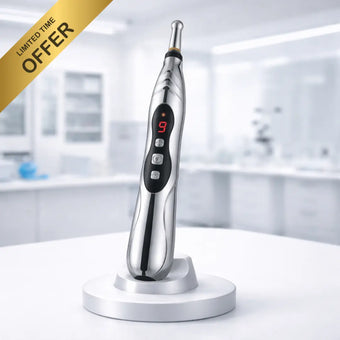
It looks like a pen. It weighs almost nothing. It fits in your pocket.
It uses a technology called NMS—Neuromuscular Stimulation—to deliver precise, low-frequency electrical micro-pulses to a nerve behind your ear called the auricular nerve.
That nerve is the reason you have tinnitus.
Not damaged hair cells. Not "hearing loss." Not your age. The nerve.
The auricular nerve is part of the signaling system between your ear and your brain. In a normal system, it fires when there's sound and goes quiet when there isn't. But in people with tinnitus, this nerve has gotten stuck. It's firing continuously—sending a constant signal to your brain that says "SOUND"—even when there's no sound at all.
Your brain receives that signal and does exactly what it's designed to do: it creates the perception of sound. Ringing. Buzzing. Hissing. Clicking. Whatever flavor of torment your tinnitus takes.
The sound is real to your brain. But it's not coming from the outside world. It's coming from a nerve that can't stop firing.
The Tinnito™ device interrupts that firing pattern.
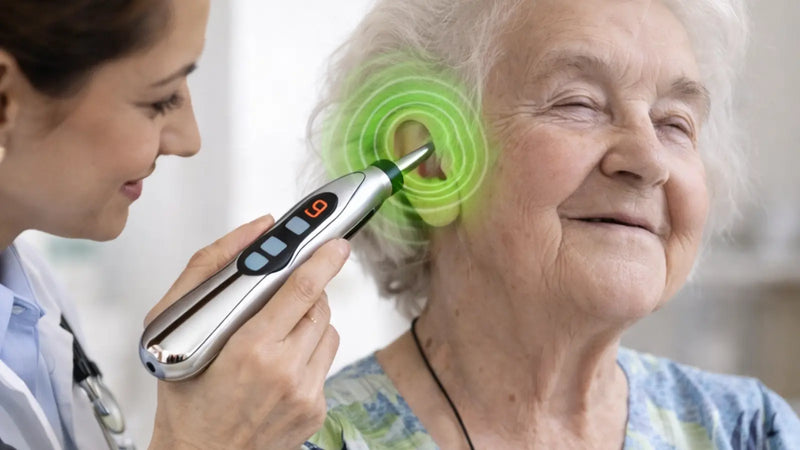
You hold it behind your ear. It sends micro-pulses through the skin to the auricular nerve. Those pulses break the nerve's stuck loop and allow it to reset to its natural resting state.
Think of it like hitting Ctrl+Alt+Delete on a frozen computer. The hardware isn't broken. The software just got stuck. You reboot it, and everything works again.
That's what NMS does to the nerve. It reboots it.
And it takes 30 seconds.
Now, before you start thinking this is too good to be true, let me address that head-on.
You're skeptical. Of course you are.
If you've had tinnitus for any length of time, you've probably tried a dozen things that promised relief and delivered nothing.
Supplements that cost $40 a bottle. Ginkgo biloba that was supposed to "increase blood flow to the ears." Zinc. Magnesium. B-vitamins. Some proprietary blend called "TinniFix" or "RingRelief" or whatever name the supplement marketers dreamed up this quarter.
None of them worked. Because none of them can reach the auricular nerve. They're absorbed into your bloodstream and distributed throughout your entire body. The tiny amount that might reach the nerve behind your ear is negligible. It's like trying to put out a house fire with a squirt gun.
Sound therapy machines that cost $200-$500. White noise. Ocean sounds. "Notch therapy." Pink noise. Brown noise. All they do is mask the ringing with a different noise. Turn off the machine, and the ringing is right back. Because the nerve is still misfiring. You didn't fix anything. You just covered it up.

Hearing aids that cost $1,000-$6,000. They amplify external sounds, which can make the tinnitus less noticeable by comparison. But the nerve is still stuck. The tinnitus is still there. You've just gotten louder earphones for the world to compete with the noise in your head.
Therapy sessions at $150-$300 each that teach you to "change your relationship with the tinnitus." CBT. Mindfulness. Acceptance. All very admirable approaches to human suffering. But the nerve is still misfiring. You haven't fixed the problem. You've just learned to suffer more gracefully.
Medications—antidepressants, anti-anxiety drugs, even experimental treatments—that come with side effects that can be worse than the tinnitus itself. Drowsiness. Weight gain. Memory fog. Sexual dysfunction. And the ringing? Still there.
You've tried all of that. Or some of it. Or you've read about it and decided it wasn't worth the money, because the reviews were mixed and nothing seemed to actually work.
And now here I am telling you about a $39.99 device that takes 30 seconds.
Yeah. I'd be skeptical too.
So don't believe me.
Test it.
That's literally all I'm asking you to do. Don't take my word for it. Don't take anyone's word for it. Take the 30-second test.
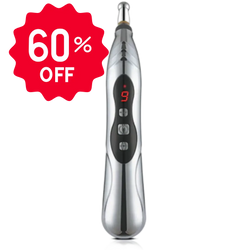
Order the device. It costs $39.99. That's 60% off the normal price of $99.99.
When it arrives—which takes just a few days—charge it up. Takes a couple of hours.
Then find a quiet moment. Sit down. Hold the tip of the device against the area right behind your ear.
Hold it there for 30 seconds.
You'll feel a gentle tingling. Warm, not painful. Some people describe it as soothing.
Then put the device down.
And listen.
Listen to what's happening inside your head.
For many people—not all, but many—the ringing will be different after those 30 seconds. Quieter. More distant. Like someone reached inside your skull and turned the volume knob down a notch.
It might be subtle the first time. Or it might be dramatic. Everyone's nervous system responds differently.
But here's what I want you to pay attention to: any change at all.
If the ringing is even slightly different—quieter, further away, less sharp—that means the NMS pulses are reaching the nerve. That means the nerve is responding. That means, with continued use over the next two to three weeks, the ringing is going to keep fading.
And if nothing changes? If the ringing is exactly the same after 30 seconds, and after a week, and after two weeks?
You send it back. Full refund. 30-day money-back guarantee.
What did you lose? Thirty seconds.
What do you stand to gain? Your life back.
Let me tell you what "your life back" actually looks like, because I think people with tinnitus forget what's on the other side.
Sleep. Real sleep. The kind where you close your eyes and drift off in minutes instead of lying awake for hours listening to the noise inside your own head. The kind where you stay asleep all night instead of jolting awake at 2 AM with the ringing screaming at you. The kind where you wake up feeling rested—actually rested—instead of exhausted before the day has even started.
Concentration. The ability to read a book without re-reading the same paragraph three times because the ringing keeps pulling your focus. The ability to sit through a meeting, a movie, a conversation without that constant noise in the background fragmenting your attention.
Peace. The ability to sit on your porch with your morning coffee and hear nothing. Not ringing. Not buzzing. Not hissing. Nothing. Just the world as it actually is—birds, wind, the neighbor's sprinkler, your own breathing.
Conversations without strain. Without leaning in. Without asking people to repeat themselves. Without faking understanding because you're too embarrassed to say "I can't hear you over the noise in my head" one more time.
Joy without an asterisk. Going to a restaurant, a concert, a family gathering, a grandchild's birthday party—and actually being present. Not enduring it. Enjoying it.
That's what 30 seconds could give you.

Now let me address the obvious question: if this technology exists and it works this well, why isn't every doctor recommending it?
Fair question. Uncomfortable answer.
NMS technology for tinnitus has existed in clinical settings for years. But in those settings, it costs $200-$500 per session. Most patients need 10-20 sessions. That's $2,000-$10,000 out of pocket, because insurance almost never covers tinnitus treatment.
That price point creates a nice business model for specialized clinics. Recurring visits. Ongoing treatment. Patients who keep coming back—and keep paying.
The Tinnito™ device delivers the same NMS technology for $39.99. One purchase. No recurring fees. No follow-up appointments. No subscription.
You don't need me to explain why the medical establishment isn't falling over itself to promote a product that eliminates recurring revenue.
This isn't a conspiracy. It's just economics. When the cure costs less than a pizza dinner, nobody makes money off your suffering anymore. And an industry built on managing chronic conditions doesn't have much incentive to promote something that resolves them.
But you're not an industry. You're a person with ringing in your ears, and you deserve to know this technology exists.
So now you know.
Here's what the Tinnito™ device actually is, in plain English.
It's a pen-shaped device, about 6 inches long. Looks sleek. Feels solid. Doesn't look medical or intimidating.
It's pre-programmed. There are no settings to fiddle with. No app to download. No Bluetooth to pair. No instructions that require a PhD to understand. You turn it on, you hold it behind your ear, it does its thing.
It comes with a charger and USB cable. Full charge lasts weeks with daily use.
It's completely painless. Zero side effects reported. It works through the skin—nothing invasive, nothing that breaks the surface.
It's endorsed by Dr. Emily Carter, a licensed audiologist in London, who recommends it to her own patients.
It has 4,394 reviews with a 4.9-star average. Over 150,000 units sold.
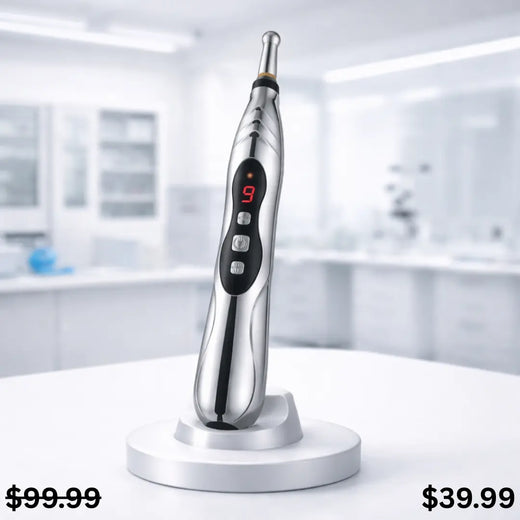
And it costs $39.99.
If you want more than one—plenty of people keep one at home and one in their bag or at their desk—you can get two for $69.98 or three for $89.97.
Let me put that price in perspective.
$39.99 is less than a month of most tinnitus supplements. Supplements that don't work because they can't reach the nerve.
$39.99 is less than the copay for a single specialist appointment. An appointment that will end with the specialist saying, "There's no cure."
$39.99 is less than a nice dinner out. A dinner you can't enjoy anyway because the ringing in your ears makes it hard to hear the person across the table.
$39.99 is less than a tank of gas. Gas that takes you to work, where you struggle to concentrate because of the constant noise.
For $39.99, you get a device backed by NMS technology, endorsed by audiologists, validated by 150,000+ users, and protected by a 30-day money-back guarantee.
There is literally no rational argument for not trying this.
Except fear.
Fear that it won't work. Fear that you'll be disappointed again. Fear that you'll let yourself hope, and the hope will be crushed like it was all those other times.
I understand that fear. I respect it. It's earned.
But I want you to think about something.
How many more nights are you going to lie awake?
How many more conversations are you going to struggle through?
How many more moments of joy are you going to experience through a filter of constant ringing?
How many more years are you going to spend "learning to live with it" when you could potentially stop it?
The Tinnito™ device is not a commitment. It's a test.
You're not signing a contract. You're not enrolling in a program. You're not starting a subscription.
You're holding a device behind your ear for 30 seconds to see what happens.
If nothing happens: return it, get refunded, move on.
If something happens: you just changed your life for $39.99.
That's the deal. That's the whole deal.
I need to tell you one more thing, and it's important.
Tinnitus gets worse over time.
Not for everyone. But for many people, the ringing gradually intensifies as the years go by. The nerve gets more entrenched in its misfiring pattern. What starts as a faint background hum becomes a roar. What starts as an annoyance becomes a disability.
The earlier you address it, the better your chances of a full reset.
I'm not saying this to scare you. I'm saying this because procrastination has a real cost when it comes to tinnitus. Every month you wait is another month the nerve gets more deeply locked into its pattern.
This isn't like a gym membership where you can "start Monday." The nerve isn't going to reset itself. It's stuck. And every day it stays stuck, it gets more stuck.
Now is the time.
Not tomorrow. Not next week. Not "when I have more money" or "when things calm down" or "when I've done more research."
Now.
I also want to be transparent about something: the Tinnito™ is a precision-engineered device. It's not mass-produced junk. The NMS technology inside it requires specific components and calibration. That means supply is limited.
When they run out of stock, they run out. And based on the sales volume—over 150,000 units—they run out frequently.
If you can see the product page and it's available, don't assume it'll be available tomorrow.
Here's the link.
Click here to get your Tinnito™ device for 60% off →
Take the 30-second test.
Hold it behind your ear. Count to thirty. See what happens.
If the ringing fades—even a little—you've just found your answer. Keep using it daily for two to three weeks and watch the ringing dissolve.
If it doesn't? Send it back. Get your $39.99 back. You lost nothing but 30 seconds.
But I want you to really think about that asymmetry for a moment.
On one side: 30 seconds and $39.99 (refundable).
On the other side: silence. Sleep. Peace. Concentration. Joy. Your life, without the ringing.
There is no rational reason to stay on the fence.
The technology is proven. The reviews are overwhelming. The guarantee removes all risk. The price is negligible.
The only thing standing between you and relief is the decision to try.
Over 150,000 people have already made that decision. 4,394 of them felt so strongly about it that they took the time to leave a review. The average was 4.9 out of 5 stars.
These aren't paid reviewers. These are people like you—people who lay awake at night, people who struggled through conversations, people who'd tried everything, people who were skeptical, people who almost didn't order it.
And then they held it behind their ear for 30 seconds.
And the ringing started to fade.

And they got their lives back.
Your turn.
What do you have to lose?
30 seconds.
What do you have to gain?
Everything the tinnitus has taken from you.
Click here to take the 30-second test →
The ringing has had your ear long enough. Time to take it back.